ANGIOLOGY and VASCULAR SURGERY at J|medical
What is Angiology? Angiology is defined as that branch of medicine that studies the anatomy and physiology of all vessels, blood and lymphatic, and their pathologies; specifically, Phlebology deals with the venous system, Lymphology with the lymphatic system; Vascular Surgery represents the operative part of angiology, as we will see in detail below.
Venous disease affects 70% of the Western population with a frequency in females triple that of males.
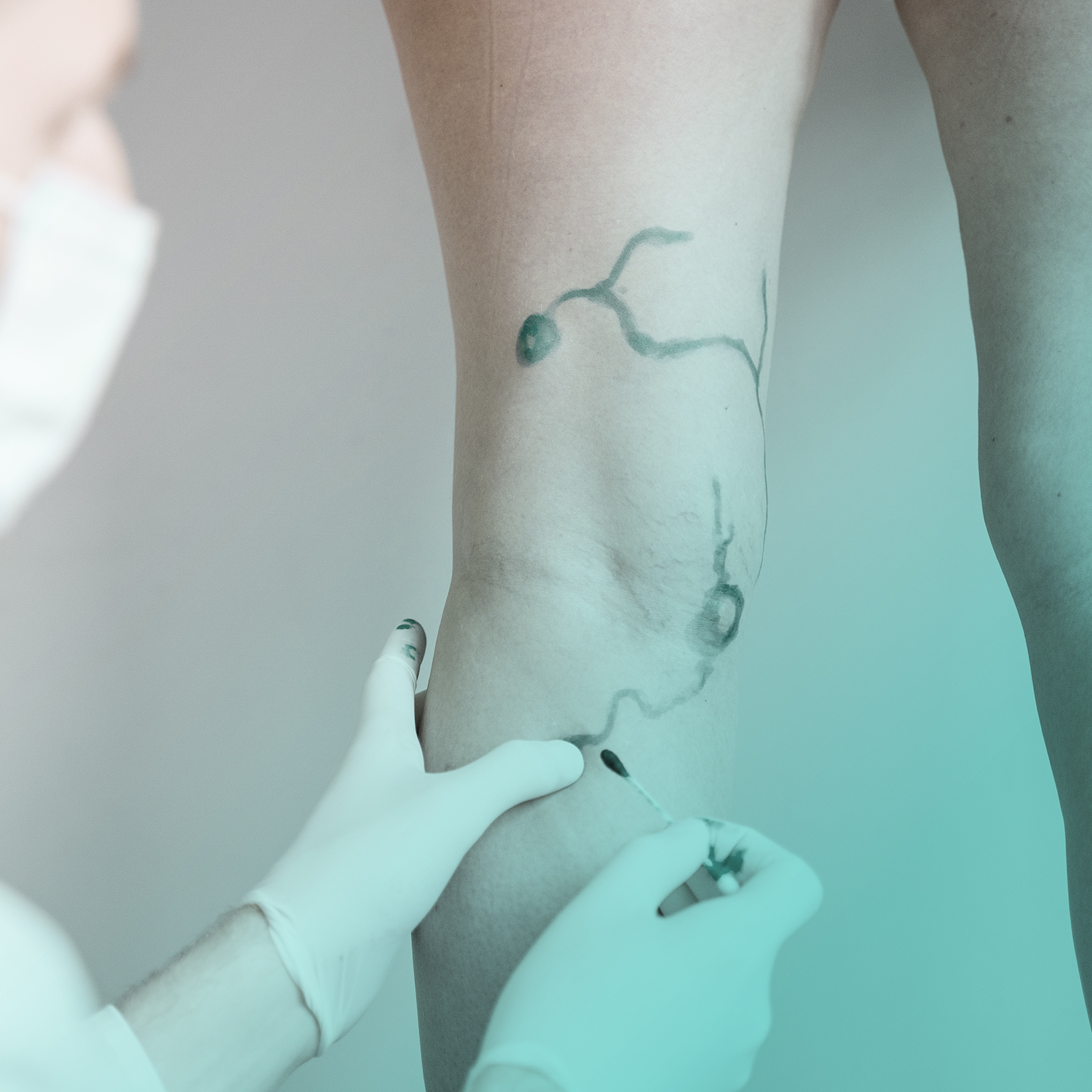
What is venous insufficiency? Venous insufficiency can range from the simple presence of dilated venous capillaries with mainly aesthetic damage (telangiectasias, angiomas, couperose, spider veins and ruby angiomas), up to the dilation of the saphenous veins of the perforating branches (varices); this may simply cause some annoying symptoms (heaviness, edema, itching, burning, tingling), or instead give rise to complications of varying severity (erysipelas, phlebitis, ulcer, hemorrhages, thrombosis and embolisms).
What does the visit consist of? The visit to the Vascular Specialist will therefore not be limited to a simple clinical and anamnestic examination with the search for any predisposing factors (family history, smoking, hypertension, hypercholesterolemia and/or hypertriglyceridemia, use of estrogen-progestins, pregnancies, obesity, sedentary lifestyle), but will include a 360° evaluation, with the use of investigations such as color Doppler ultrasound, which allows exploring the anatomy of the vessels, their course, the presence of narrowing (stenosis), dilations (varices), obstructions (thrombosis), to evaluate the speed of blood inside them (flows); the possible presence of complications (hematomas, hemorrhages, thromboembolic disease) will also be investigated, in addition to evaluating the possible evolution of the venous disease and its impact on the organism.
Exploration with color Doppler ultrasound will also allow exploring the arterial side of the circulatory stream, thus being able to highlight any distal arteriopathy (atherosclerosis or obliterating arteriopathy of the lower limbs) or even an arteriopathy of the cervico-cephalic district (search for carotid or vertebral stenosis) for more effective prevention of cerebral ischemic disease (stroke or TIA).
A particular look will be directed at the lymphatic system, frequently correlated with a disease of the venous system, and whose malfunction can determine edema of both upper and lower limbs (lymphedema, lympho-phlebedema); disorders of the lymphatic system can arise following trauma, previous thrombosis, after some operations for removal or irradiation of lymph glands for tumor pathologies (mastectomy, prostatectomy, hystero-adnexectomy), can be linked to the presence of infectious pathologies (dermohypodermitis) but in some cases are congenital or idiopathic (without evident cause).
What is vascular surgery? Vascular Surgery represents, as we said, the operative part of angiology, setting itself as a therapeutic objective the “repair” of anatomical defects of the circulatory system; regarding arterial disease, we will then talk about stents, bypasses, vascular prostheses, endoprostheses, endarterectomy.
Regarding instead more specifically venous surgery of the lower limbs, despite considerable progress in the cure of varices (dilated and incontinent varicose veins, in particular great and small saphenous, the most frequent), at the European level 98% of interventions on varicose veins are still performed with a technique dating back to 1903, called stripping; towards the end of the 80s conservative surgery (CHIVA) began to take hold, which will not encounter much enthusiasm due to the difficulty of execution and the possible incompleteness of the surgical act, and thermo-ablative surgery (LASER, radiofrequencies), which is based on the principle of closing the vein through an overheating process that causes spontaneous thrombosis.
Although thermo-ablative surgery is still little used, it certainly offers a notable improvement compared to classic surgery, including minimally invasive surgery. The main hurdle is painfulness (correlated to the high temperatures produced by the laser and radiofrequencies), which requires the execution of anesthesia, epidural or very extensive local (perivenous infiltration). Furthermore, the post-operative period is not free from possible inflammatory and neurological complications (lesion of the saphenous nerve) and varicose recurrences (reformation of veins).
For some months now, a revolutionary intervention has been admitted in Italy, already validated in the USA and other European countries (UK, Germany, Denmark, and Holland); this intervention, which is to be considered ablative, uses a particular type of biological glue to close the vein from the inside, in a non-invasive and totally painless way.
This technique (covered by the VenaSeal-Sapheon patent of one of the world’s largest biomedical technology companies, Medtronic, and experimented since 2012) consists in the use of a highly biocompatible glue (cyanoacrylate) specially modified so as to polymerize upon contact with plasma and not create adverse reactions, scars, or intravascular hardenings; the glue arrives in the affected veins through an endoluminal catheter; this catheter, inserted with an ultrasound-guided and totally painless procedure, is brought to the point of the vein affected by insufficiency or varicosity; once a minimal amount of glue is deposited, the vein is compressed, always under ultrasound control, to allow the polymerization of the cyanoacrylate and the definitive closure of the vein. The entire procedure is controlled instant by instant thanks to the use of the ultrasound scanner, which allows visualization of the vein along its entire course, of the catheter and of the glue, just as it allows verifying in real-time that the vein has been closed.
Precisely the minimal invasiveness of the procedure allows proposing it also to patients taking anticoagulants, without risks and without interruption of therapy.
This technique also allows immediate resumption of mobility, absence of complications, avoids interruption of work activity, and above all leaves no scars, not requiring skin incisions or actual surgical procedures; in some cases, the use of an anti-thrombus mono-pantyhose may be advisable for a few days.
Current statistics demonstrate a net improvement in the resolution of varicose disease through this VenaSeal technique compared to other ablative techniques (laser and radiofrequencies), with a result of 98.9% for VenaSeal against 95% for radiofrequencies and laser.
What do I find at J|medical? At J|medical there is now a team specialized in the realization of this technique, which promises to change the landscape of venous surgery.
The Endovascular Varicose Vein Surgery team at J|medical, composed of Doctor Jean Pierre Candido, vascular surgeon from the faculty of Paris and Member of the Societé Française de Chirurgie Vasculaire, and Doctor Cristina Garrino, internist specialized in invasive ultrasound-guided procedures and in particular in endovascular catheter placement, proposes the resolution of varicose disease and its complications through an innovative technique completely painless, non-invasive, rapid, outpatient, and free of side effects or sequelae such as scars, paresthesia, or skin discoloration.
- Angiological services performed on an outpatient basis:
- Sclerotherapy
- ScleroAngioLaser
- Laser
- Ulcer Laser
- Foam
- Ulcer Medication
Vascular Bandaging
Angiological services performed in the operating room:
- VenaSeal (biological glue)
- Phlebological surgery
- Phlebectomy according to Muller
- Crossectomy
- Minimally Invasive Vascular Surgery
- Closure Intervention (radiofrequencies)
- Perforating vein surgery
- ASVAL
- Ulcer PRP
- Ulcer surgery
- Skin grafts